
Helping Kids Speak With Confidence Through Martial Arts
A public speaking class disguised as a martial arts class.
At Bill Stevens karate and Jiu-jitsu in Ramsey, NJ, we believe one of the most valuable skills a child can develop is the ability to speak with confidence.
Learning martial arts is important, but we want our students to gain skills that extend far beyond the martial arts school. We want children to feel comfortable making eye contact, speaking clearly, expressing themselves, helping others and stepping forward when an opportunity to lead presents itself.
That's why we incorporate communication, public speaking and leadership exercises directly into our martial arts classes.
Confidence Is a Skill That Can Be Practiced
Some children naturally enjoy being the center of attention. Others are quiet, hesitant or uncomfortable speaking in front of a group.
We understand that every child develops at a different pace.
A child who is nervous about speaking in front of an entire class may feel much more comfortable practicing with just two other students.
Our approach is to start with small, achievable challenges and gradually build toward greater responsibilities.
Over time, students learn to:
- Stand tall and demonstrate confident posture
- Make appropriate eye contact
- Speak clearly and loudly enough to be heard
- Use respectful words and communicate effectively
- Give instructions and lead small groups
- Encourage and support their training partners
- Demonstrate techniques in front of others
- Develop the confidence to speak in front of an entire class
These skills are not developed through lectures alone. They are learned through practice, repetition and positive experiences.
Step 1: Learning to Communicate Through Words and Movement
Our communication training begins with our monthly Life Skills curriculum.
Each month, students explore a different character-building theme, such as honesty, respect, responsibility or perseverance.
Each Life Skill may include up to eight individual pillars, with each pillar represented by both a word and a physical movement.
Students practice saying the word aloud while performing the corresponding hand gesture.
Why do we combine speaking with movement?
Think about how people communicate in everyday conversations. We naturally use our hands, facial expressions and body language to help explain our thoughts and tell stories.
Our Life Skills exercises introduce children to the connection between verbal and nonverbal communication in a fun, structured way.
Instead of simply memorizing a word, students practice expressing it with both their voice and body.
It's a simple starting point for developing awareness of how we communicate.

Step 2: The Leadership Triangle — Learning to Lead a Small Group
One of my favorite communication exercises is something we call the Leadership Triangle.
Three students work together in a small group.
One student becomes the leader, while the other two take on the role of students.
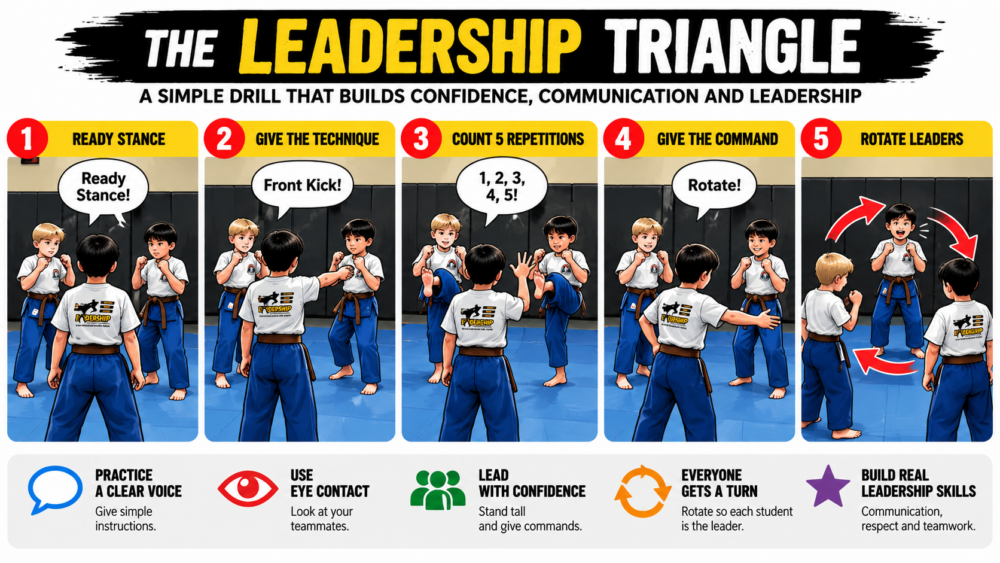
The leader is responsible for giving simple martial arts instructions:
- Ask the group to get into a ready stance.
- Announce the kick, punch or strike they will practice.
- Count five repetitions while the other students perform the technique.
- Give the command to rotate.
- Allow the next student to become the leader.
Each child gets a turn leading the group.
Although the exercise looks like a simple martial arts drill, something much more important is happening.
The student leading the triangle must practice speaking clearly, giving directions, standing with confidence and taking responsibility for the group.
The other students practice listening, following instructions and showing respect to their leader.
It's a beginner public speaking exercise built right into a karate class.
For children who are uncomfortable speaking in front of others, leading two classmates is often a much more approachable first step than standing in front of an entire room.

Step 3: Making Leadership Fun
We believe children learn best when they're engaged and enjoying themselves.
That's why we regularly introduce creative variations into our leadership exercises.
Sometimes students must lead their group in slow motion.
Other times, everything happens at extra-fast speed.
We may challenge a student to teach an entire drill without speaking, using only hand gestures and body language.
We also intentionally introduce silly mistakes into certain exercises and challenge students to recognize and correct them.
These games encourage children to pay attention, think carefully and communicate in different ways.
They also take some of the pressure out of public speaking.
When children are laughing, participating and having fun, they may become more willing to try something that previously made them nervous.
Our goal is to make speaking and leading feel like a natural, enjoyable part of martial arts training.
Step 4: From Leading Two Students to Leading the Entire Class
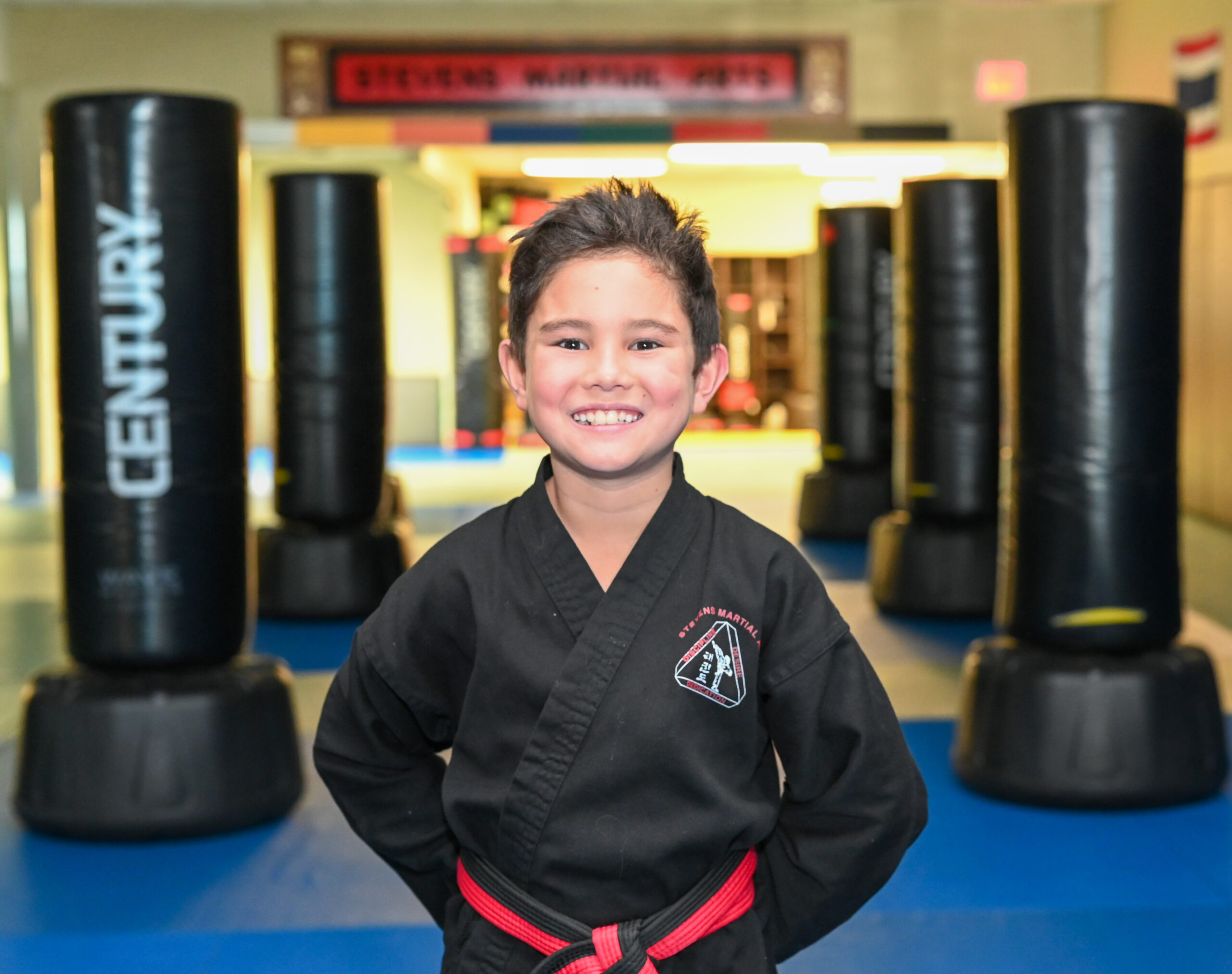
As students become more comfortable leading their small triangle groups, we gradually introduce bigger opportunities.
When they're ready, students in our Leadership Program may be invited to stand in front of the class and lead an exercise or warm-up.
Imagine the difference between these two experiences:
A child who once struggled to speak loudly enough for two classmates to hear is now confidently giving instructions to an entire room of students.
That progress doesn't necessarily happen overnight.
It develops through practice, encouragement and many small successes.
We don't expect every child to become an outgoing public speaker. We want each student to become more comfortable using their own voice.
Real Leadership Is Learned Through Experience
Leadership is more than being the loudest person in the room.
A good leader also knows how to listen, encourage others, demonstrate patience and set a positive example.
Throughout our martial arts classes, students have opportunities to:
- Help newer students learn techniques
- Demonstrate skills for classmates
- Encourage partners who are struggling
- Lead drills and warm-ups
- Practice respectful communication
- Remain calm when things don't go as planned
- Take responsibility for their actions
- Keep trying when something is difficult
These experiences give children meaningful opportunities to practice leadership rather than simply hear about it.
A student who once stood quietly in the back of the class may eventually be the first to help someone new.
A child who once whispered may begin counting repetitions with a strong, clear voice.
A student who once avoided attention may volunteer to demonstrate in front of the group.
These are the moments that make teaching martial arts so rewarding.
Helping Quiet and Shy Children Find Their Confident Voice
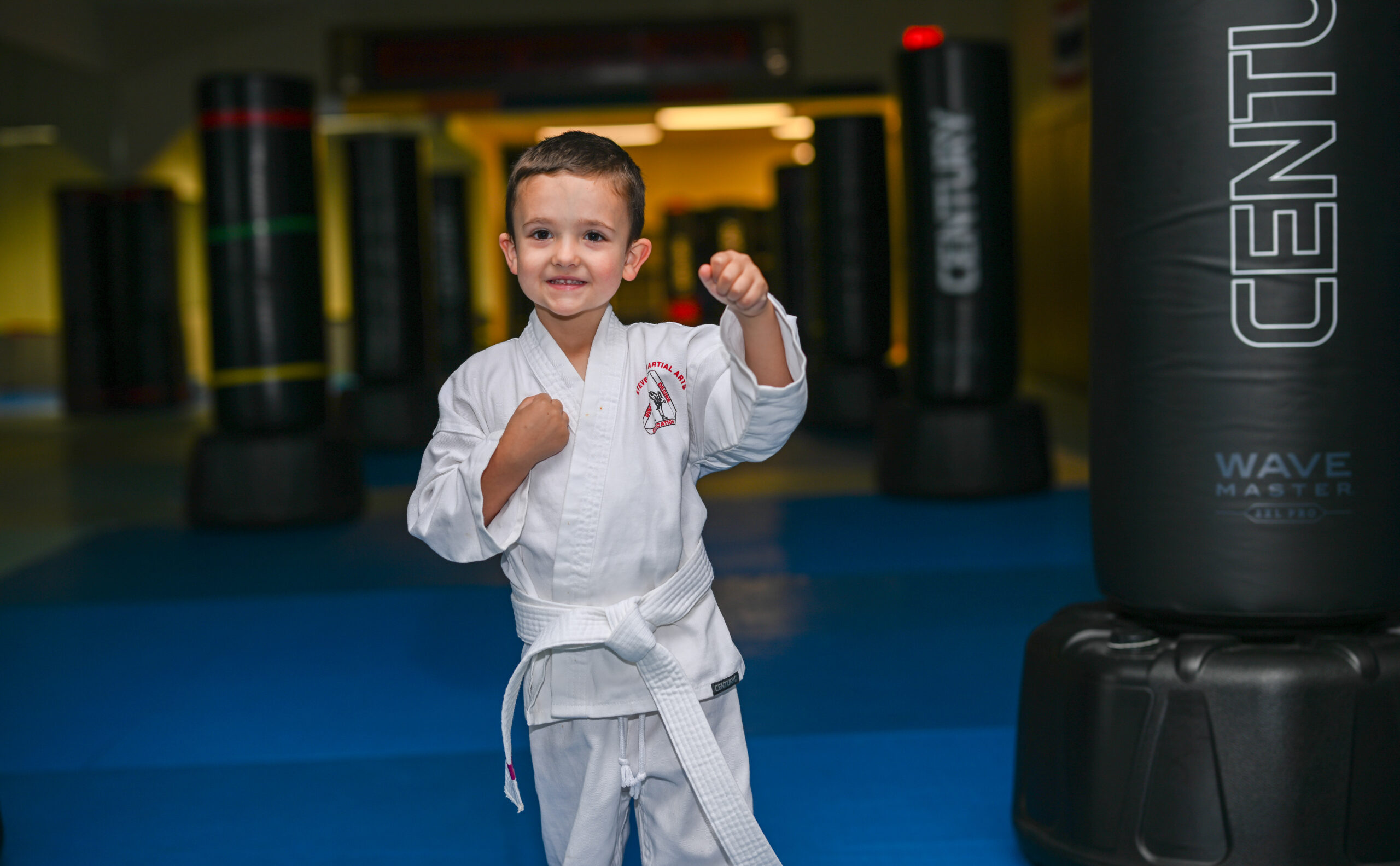
Not every child enters our school feeling confident.
Some children are hesitant to answer questions, uncomfortable making eye contact or nervous about speaking in front of others.
We don't believe confidence can be forced.
Instead, we create opportunities for children to experience success in situations that gradually become more challenging.
A quiet student might begin by saying one Life Skill word aloud.
Next, they may practice giving directions to two classmates.
Eventually, they might feel comfortable leading a larger group.
Each step builds on the one before it.
Our instructors encourage participation without expecting every child to progress at the same speed.
Over time, even soft-spoken children can make meaningful improvements in how comfortably and clearly they communicate.
How Parents Can Encourage Leadership at Home
Parents don't need a complicated leadership curriculum to help their children develop communication skills.
Everyday family activities provide excellent opportunities to practice.
Let your child speak for themselves.
Encourage them to order their own food at a restaurant, greet adults, thank their instructors, introduce themselves or ask a question when they need help.
Give children age-appropriate opportunities to make decisions, explain their choices and take responsibility for small tasks.
When your child speaks up or tries something that makes them nervous, recognize the effort.
The goal isn't perfect public speaking.
It's helping children become comfortable expressing themselves and learning that their voice matters.
The skills we practice at Stevens Martial Arts can be reinforced at home, at school and throughout everyday life.
More Than Karate — Skills for Life
I've been teaching martial arts in Bergen County since 1989, and one of the most rewarding parts of my work has been watching children grow in confidence.
Of course, I'm proud when students learn a difficult technique, earn a new belt or reach Black Belt level.
But I'm equally proud when a child who was once afraid to speak in front of others stands tall and confidently leads a group.
That's the kind of progress that can stay with a child long after class ends.
At Stevens Martial Arts, we teach karate, self-defense and physical skills. But we also use martial arts as a way to develop communication, character and leadership.
We want our students to leave with more than martial arts skills. We want them to leave knowing they have a voice worth hearing.
Discover the Stevens Martial Arts Difference
If you're looking for a children's martial arts program in Ramsey, NJ that goes beyond kicks and punches, we invite you to visit Stevens Martial Arts.
Our classes combine age-appropriate martial arts instruction with opportunities to build confidence, improve focus, develop communication skills and practice leadership.
We proudly welcome families from Ramsey, Mahwah, Allendale, Upper Saddle River, Saddle River, Ho-Ho-Kus and surrounding Bergen County communities.
Start with a FREE trial week and see how we help children speak with confidence.
Call us today: 201-327-7702
Stevens Martial Arts / Bill Stevens Karate
91 Interstate Shopping Center, Ramsey, NJ 07446